


We would love to learn about your project and if you feel The Chameleon Agency might be the right agency to support you. Please get in touch for a no obligations chat to see if we’re right for each other.

Almost half of UK workers say they feel connected with their role and aligned with their organisation’s values and purpose, our latest research has found. But scratch the surface and a slightly more complicated picture emerges.
We recently surveyed 1,000+ UK employees at organisations of different sizes and across various sectors and found a sense of creeping disconnection, discontent with how organisations communicate, and a lack of connection to the bigger picture. Ultimately, the research shows a workforce whose relationship with their employer is far more delicate than it appears.
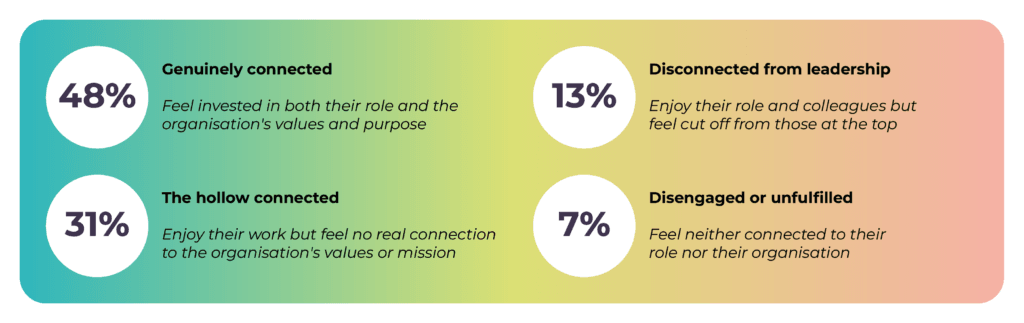
When we asked UK workers how they feel about their jobs, the headline looked positive. Nearly half say they generally feel connected in their role and their values are reflected in where they work. But the data tells a more complicated story.
Nearly a third of the workforce falls into a category we call the hollow connected – people who are generally content day-to-day but disconnected from the organisation’s purpose and values. They’re not unhappy, but equally, they’re not invested. We often find that these people pose the biggest flight risk and are the first to leave when something better comes along.
This distinction matters because when we look at behavioural research – including Gallup’s long-running workplace engagement studies – it consistently finds that the proportion of workers who are truly engaged with their organisation is far smaller than workers report in more sentiment-based surveys.
Our data helps explain why: positive feelings about work and genuine organisational commitment are different things. Unfortunately, many internal communications strategies treat them as one.
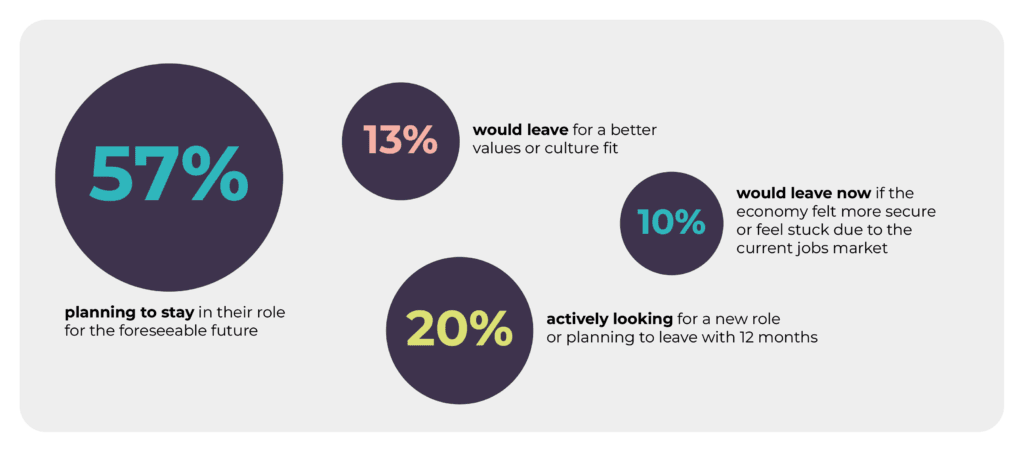
Flight risk is not just a junior employee problem. Directors are among the highest-risk groups, with nearly 29% planning to leave or actively looking. Add in the workers who are only staying because the jobs market feels uncertain, and the true scale of latent attrition becomes clear.
The data also reveals a values-driven element to turnover that HR and internal comms teams can’t afford to ignore. More than one in 10 (13%) say they would leave for a role that better aligns with their values or interests – a number that rises sharply among younger workers and mid-level professionals.
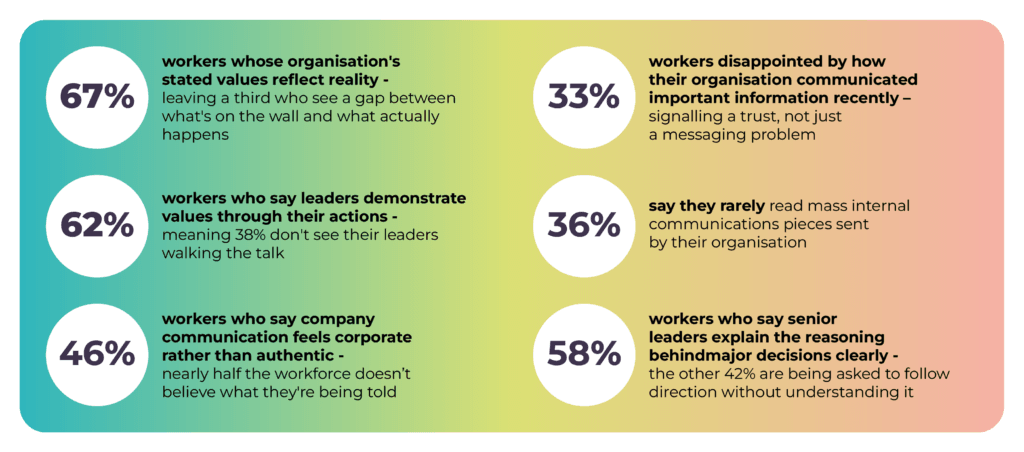
Our survey also revealed mixed feelings on values, leadership behaviours and how they are communicated with day-to-day.
When it comes to what makes people feel connected at work, the results were pretty clear. Face-to-face dominates, ranked first by 62% of workers – more than all other channels combined – and in the top three choices for almost all (89%). And 65% say that in-person company events actively increase their sense of connection.
Here at Chameleon, we’re seeing a real increase in desire for genuine face-to-face connection via in person-events. This stems from a mix of fatigue from years of virtual-only meetings and the proliferation of AI meaning many of us are craving that genuine connection. Indeed, our research showed that almost half of workers would like more face-to-face contact with their colleagues.
However, access to the right channels is only half the problem. The more urgent issue is what happens when organisations do communicate, regardless of if this is face-to-face or online. And at the moment, many workers don’t believe it.
46% say company communication feels corporate rather than authentic. A third have been disappointed by how their organisation has handled the communication of important news over the past year. And a clear gap opens up between satisfaction with line manager (72% positive) and senior leadership (60% positive) communication – indicating the closer the communicator to the employee, the more trusted they are.
The graph below indicates the percentage of respondents who put the named responses in their top three when asked “Which communication method makes you feel most connected to your organisation?”

Managers are often the people expected to bring internal communication to life. They translate leadership messages, explain decisions, reinforce values and help teams understand what changes mean in practice.
But our research suggests many are not feeling fully connected or well served by internal comms themselves with more than two in five managers saying they enjoy their role but don’t feel connected to their organisation’s values and purpose. Almost a fifth don’t feel company communication is relevant to them and their role, while almost a quarter don’t think leaders explain the reasoning behind major decisions clearly.
We’re calling this ‘the manager gap’ and it’s one of the most significant findings of our research. Managers cannot be expected to build connection for everyone else if they are left disconnected themselves. If organisations want employees to understand, believe in and get behind the bigger picture, managers need to be treated as a critical audience in their own right.
We work with internal comms, HR, and leadership teams to build engagement, buy-in and sentiment through events and experiential that make an impact. If any of the data in our latest research resonates, we’d love to hear from you.
Methodology
This research was conducted by Sensu Insight on behalf of Chameleon in April 2026 with 1,014 UK workers across sectors, organisation sizes, seniority levels, and working arrangements. All figures are based on self-reported sentiment – how workers feel about their role and organisation at the time of survey.
Sentiment research of this kind measures how people feel about their work – their sense of connection, meaning, and alignment. This is distinct from behavioural engagement frameworks, such as those used by Gallup, which measure how that feeling translates into observable workplace behaviours. The two approaches ask different questions and should be read accordingly.
We would love to learn about your project and if you feel The Chameleon Agency might be the right agency to support you. Please get in touch for a no obligations chat to see if we’re right for each other.

Chameleon Agency
Colony, Piccadilly Place,
5 Aytoun St
Manchester
M1 3BR